
portainer
extension
Portainer management tool — session-scoped API config, ad-hoc requests, and orchestration workflows for endpoints, stacks, containers, images, networks, and volumes
Portainer API management through one session-scoped portainer tool. Requires Piclaw >=1.8.0.
Open Settings → Add-Ons, install portainer, then configure Settings → Portainer.
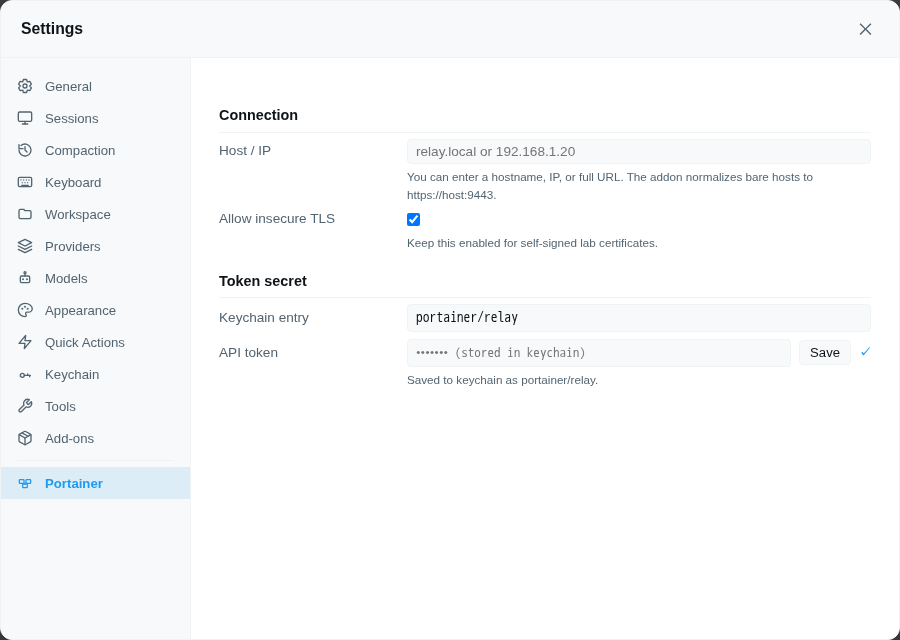
Non-secret defaults use /agent/addons/api/portainer/config and extension KV. Store the API token in the keychain; the default entry is portainer/relay. Hostnames and bare IP addresses are normalised to https://<host>:9443.
get, set, clear — session override managementdiscover — find settings, environment, and keychain candidatescontract, capabilities, workflow_help, request_help, recommend — inspect the tool contract before calling itrequest — one raw Portainer API request or a bounded sequential batchworkflow — named endpoint, stack, container, image, network, or volume workflowUse portainer capabilities for workflow families and portainer workflow_help for required fields. Raw requests support retries, throttling, per-request timeouts, and optional workspace JSON/JSONL output.
allow_insecure_tls is enabled.The bundled portainer-container-compare-chart skill collects bounded container stats through the tool and renders SVG/CSV comparison artifacts.
Text-like fields use the host's shared settings-addon-* controls and associated
labels, matching core Settings in Classic and Visual without changing save
payloads, defaults or secret handling. A package-local layered stylesheet keeps
older supported hosts readable; host rules take precedence when available.
Native checkboxes and action buttons retain their own control roles.
createPortainerTool(options) exports the same schema/actions without registering an
extension or constructing an agent session/context. Required options are
chatJid: string and assertCurrent(): void. A supplied chat_jid must match
that captured chat; omission uses the captured chat, never an ambient default.
getPortainerPrompt() returns the complete lifecycle prompt text without callbacks.
The default extension still registers its tool, lifecycle hook and static skill.
Optional invocation-local ports:
transport: RequestExecutor (exported from client.ts); defaults to the existing
production transport, not the legacy test-executor override.credentials: { get(name): Promise<KeychainEntry>, list(): KeychainEntryMetadata[] };
defaults to the existing environment/runtime/CLI credential resolution.Async-local authority is checked at credential lookup, HTTP dispatch, each
batch attempt/retry, profile storage and output-file effects. Workflow HTTP
steps inherit that same scope, including guest/container exec steps. Scope is
closed on completion so timed-out continuations cannot begin later effects.
Native calls do not use the legacy global setPortainerToolHandlers override: an
arbitrary handler cannot provide internal operation fences. No handler swaps
are performed. Already-dispatched remote effects cannot be rolled back.