
code-review
extension
Saved-source and Git-diff reviews with durable inline discussions and explicit queued agent work
Review saved source and Git diffs in Classic, keep inline discussions and private drafts, and send new or updated discussions to a local agent. Source is read-only; posting a comment does not start agent work.
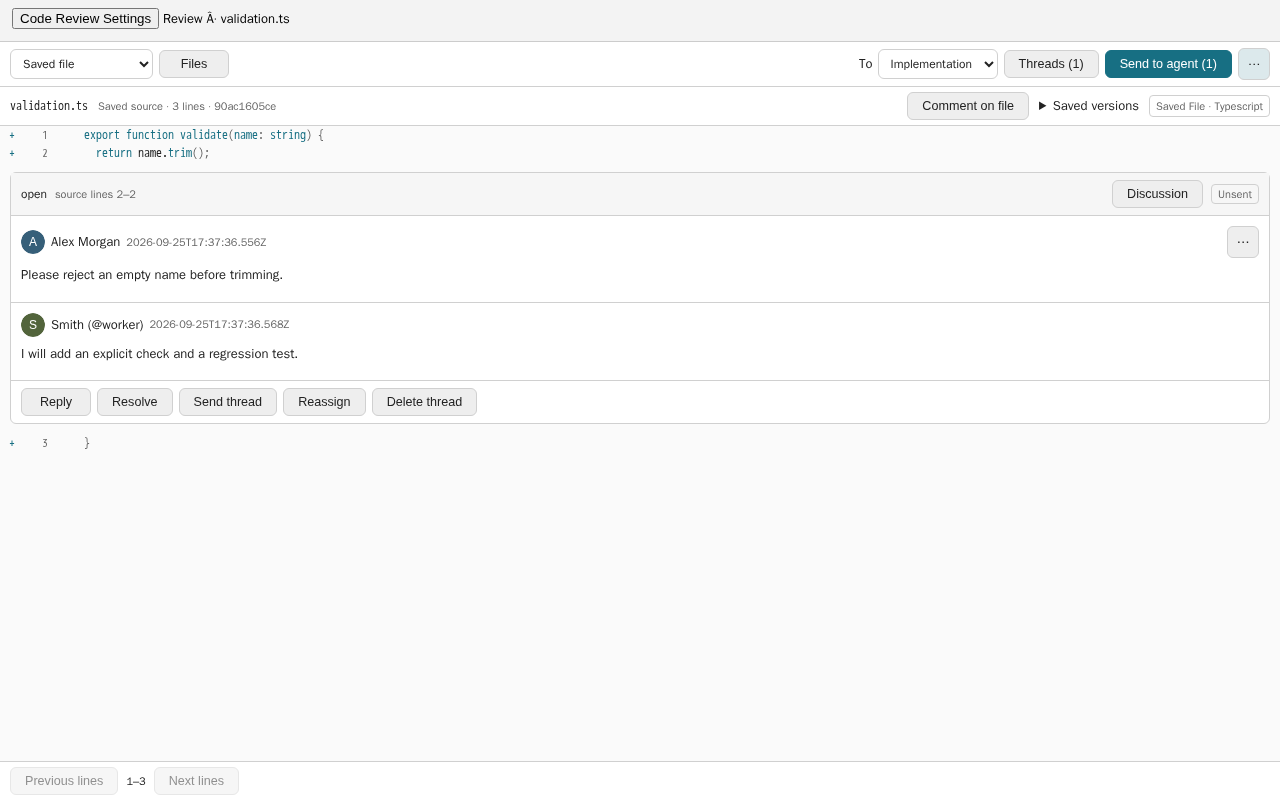
Classic pane, rendered from the real add-on with disposable sample source and profiles. The screenshot uses no live review data.
Open Settings → Add-ons → Code Review for the Reviews list. Open uses the stored review ID and snapshots, so it works after the source file is renamed or deleted. Closing a review tab only closes its pane.
Delete permanently removes that review's messages, revisions, private drafts, snapshots and stored source bytes from the active add-on database. Source files are never deleted. Confirmation is required; an in-flight send must finish first. Already accepted work cannot be recalled, but subsequent review-tool reads/writes fail once the review is deleted. Minimal body-free request tombstones prevent old requests from recreating it. Backups and already-delivered instructions are not erased; this is logical deletion, not a forensic purge of SQLite pages.
Automatically delete reviews older than N days is off by default. Enable it with confirmation and a whole number from 1 to 3650 days. Age means time since last review activity, including recent drafts. The add-on checks hourly after a verified workspace context has been seen, and when Settings refreshes, deleting up to 100 old reviews per pass. The saved policy survives restart. Queued, running and uncertain work is skipped; inactive unsent discussions can expire under this policy. Reviews in another workspace are never selected by the cleanup pass.
The active release checklist is six Classic-only checks in
specs/code-review/ACCEPTANCE.md. The 184 older Gherkin IDs remain archived
design reference, not individual release gates. Run bun addons/code-review/coverage.ts
from the repository root for the compact checklist (--legacy includes the old
inventory). No checklist row passes merely because a test mentions its ID.
The agreed mockup's Classic layout, controls and interactions are still required;
the simplified checklist does not authorise UX deviations.
Requires Piclaw 3.2.3 or later, using Classic. Version 3.2.3 is the first tagged release containing the required add-on APIs from PR #1407. Version 3.2.2 does not contain them. Visual is not supported for this release.
The pane feature-detects __piclaw_web.workspaceActionsVersion === 1; the backend
requires __piclaw_runtime.localContext.version === 1 and host-verified submission
references. Its route is piclaw://addon/code-review/<id>. The package declares
compatibleVersions: ">=3.2.3"; the packed add-on is tested against the tagged
3.2.3 source in a disposable authenticated host.
The host supplies trusted operator or explicit review-dispatch agent identity.
Ordinary legacy prompts, side/scheduled tasks and remote-origin turns do not gain
review authority from an ambient chat ID. Code Review requires the host-verified
reference: {addonId, intentId} for the current submission. Each Send may include
many concerns/files; another Send has separate review-tool scope even in the same
review/chat. The host implementation and evidence are documented in
specs/code-review/CR-079-HOST-CONTRACT.md. If agent context is unavailable, use
Send to agent from an authorised review. Direct API fields never establish
ownership. Browser actions are authenticated; there are no external peer routes.
messaging.getAddonDataDir('code-review')/reviews.db belongs to this add-on. Do not
point it at Piclaw's core message database. Snapshots and review records are
versioned; uninstall must retain the directory. Back up the SQLite database
consistently, including any WAL state. Destructive reset is not an implicit upgrade.
From the repository root, retain the checked-in test preloads:
bun test addons/code-review
./node_modules/.bin/tsc --noEmit -p addons/code-review/tsconfig.json
The browser integration test creates its own ephemeral loopback server, database,
workspace, profile and fake queue adapter. PICLAW_REVIEW_TEST_BROWSER may name an
existing Chromium executable; it never names a target server. No paid provider or
live Piclaw instance is used. The opt-in host.optional.test.ts instead boots
a disposable Piclaw worktree with its own workspace, profile and SQLite store;
PICLAW_REVIEW_AUTH_TEST=1 enables a fixture-only TOTP session, and
PICLAW_REVIEW_AGENT_TEST=1 uses a deterministic local provider. Set
PICLAW_REVIEW_PACKAGE_TARBALL to a locally packed tarball to replace the
source-tree copy and install its production dependencies in that fixture.
It never installs or reloads the running instance. The acceptance ledger records
verified Classic flows and the platform/stress combinations not covered.
Agent thread reads compare the bounded current saved file against the original
anchor side. The currentSource status is observational and may be unverified
for Git/index/commit snapshots without a saved-file identity. It returns no
current source text or digest; use ordinary authorised source tools to inspect
changed code. The original anchor, saved bytes and history remain unchanged.
If a public reply commits but its response is lost, the pane stores only the request, thread and optional draft identifiers in same-origin browser storage. The pane offers explicit receipt reconciliation after reload or in another tab; it never resends automatically. The server checks the current operator, actor, review and thread before returning a body-free receipt. A missing receipt retains the acknowledged draft. If the marker is unreadable, reply posting is blocked until the operator confirms clearing that browser marker after checking saved replies and drafts. The browser marker contains only identifiers and grants no authority; every lookup requires a current authorised session. It is not automatically expired on sign-out. Clear it explicitly from the pane after checking the saved reply.
Install dependencies for this package using bun install in its directory. Source
capture uses safe Git argv and bounded UTF-8 regular-file reads. Syntax parsing
uses packaged Lezer dependencies and returns escaped plain text on unsupported or
large input.
The pane uses Unsent, Queued, Failed, and Delivery uncertain, with agent work state shown separately. A persisted work state is not evidence that an agent process is still running.
Installing/removing an add-on requires the normal host restart to load/unload it. Do not reset the database or downgrade its schema. Back it up consistently before upgrading the host or package.